

MARKET OVERVIEW
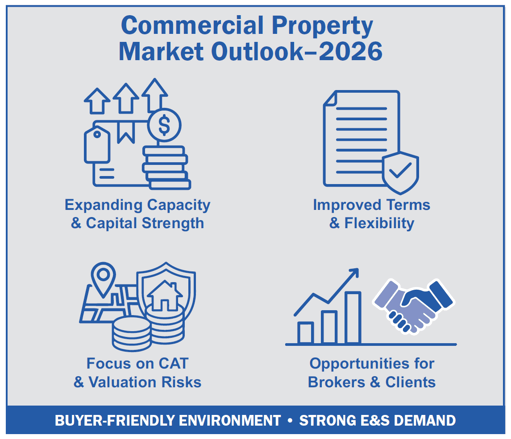
The US commercial property insurance market has entered in a notably more buyer-favorable manner for well-positioned accounts, while underwriting discipline continues to vary meaningfully by exposure profile, geography and catastrophe aggregation. As reflected in published market commentary and rating-agency outlooks, including AM Best and Fitch Ratings, capital support across the insurance and reinsurance markets has potentially broadened entering the second quarter of 2026, supported by improved underwriting profitability relative to prior cycles. These dynamics have contributed to an increase in available insurance capacity and heightened competition among insurers for well performing property risks, particularly in layers where excess capacity is most evident. Retail clients are seeing carriers more willing to deploy capacity, participate in larger line sizes, and engage earlier and more constructively in renewal discussions.
Pricing conditions are now translating into tangible renewal outcomes, particularly for well-modeled accounts and shared or layered placements where excess capacity is most available. As a result, renewal discussions remain more focused on rate outcomes, while placing increased emphasis on overall program efficiency. Published market analyses from Insurance Business America, supported by broader industry commentary summarized in Insurance Partners and Business Insurance, indicate that multicarrier layered program structures have achieved premium relief in the 10%–30% range, with select placements experiencing more pronounced reductions. Meanwhile, single-carrier and smaller middle-market placements have experienced less rate volatility. Overall, loss-free and well-performing accounts have tended to receive more favorable consideration. In many cases, this environment is also enabling buyers to secure incremental capacity, enhance program structure or revisit deductibles and terms that became restrictive during prior market conditions.
According to the Wholesale & Specialty Insurance Association (WSIA) 2025 Annual Stamping Office Report, surplus lines premium reported across the15 stamping-office states reached approximately $90.3 billion in 2025, representing 7.8% year-over-year growth. Because stamping office states represent only a portion of nationwide surplus lines activity, WSIA and industry analysts estimate total US Excess & Surplus Lines (E&S) premium to exceed $130 billion annually. Property business continues to represent a significant component of the E&S market, reflecting exposure complexity, catastrophe aggregation, valuation sensitivity and the ongoing retrenchment of admitted capacity.
After several years of elevated insured losses, 2025 proved to be a comparatively benign year, supporting stronger insurer results and helping to shape renewal dynamics entering 2026, with implications that vary meaningfully by peril and geography, as discussed herein.
In a competitive market, disciplined placement strategy and strong underwriting dialogue matter more than ever, and RT Specialty looks forward to collaborating with you to make the most of the opportunities ahead.
REINSURANCE
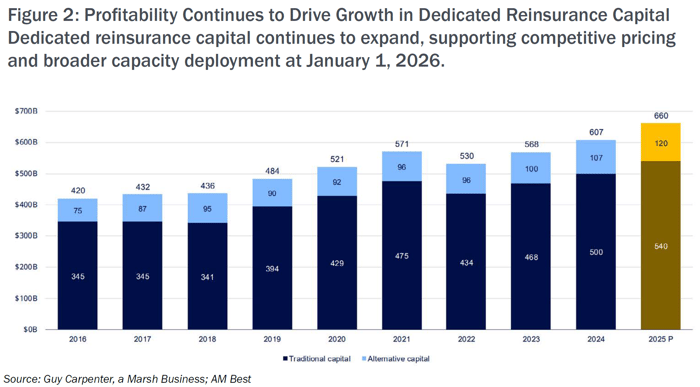
The January 1, 2026, reinsurance renewals marked a meaningful reset in global property reinsurance conditions. After several years of rising costs, reduced capacity and tighter structures following elevated catastrophe losses, renewal outcomes were further supported by record reinsurer capital levels, including continued growth in alternative capital, as noted by Aon Re.
According to the Guy Carpenter January 1, 2026, Reinsurance Renewal Report, reinsurers’ share of global catastrophe losses has declined significantly since 2023, reflecting higher attachment points and reduced exposure to frequency losses, which has supported improved earnings stability despite recent catastrophe volatility.
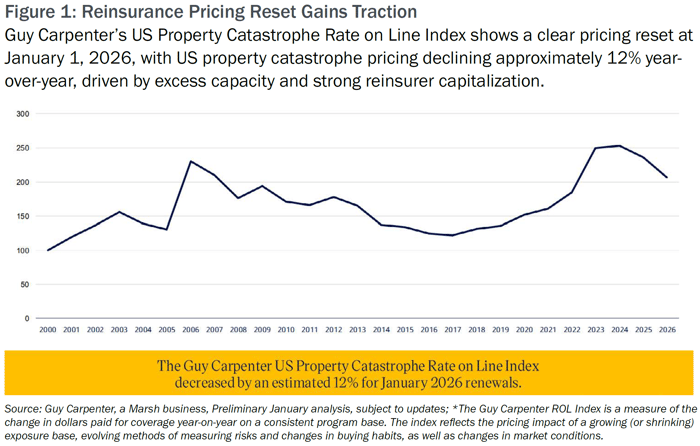
Guy Carpenter reported double-digit risk-adjusted rate decreases for many non-loss- impacted programs, with demand for additional limits increasing modestly and being readily absorbed by available capacity. See Figures 1 and 2.
Gallagher Re, in its First View: Options and Opportunities report, noted that many buyers prioritized securing pricing relief over expanding coverage, with structural outcomes remaining selective and data-driven.
S&P Global Market Intelligence, in its January 2026 analysis of the renewals, reported that global property catastrophe Rate on Line indices fell by mid-teens percentages at January 1, reflecting surplus capacity relative to demand. S&P also highlighted that, while reinsurers conceded pricing, they remained selective about coverage changes and were willing to walk away from proposals that fell outside underwriting parameters. Regional differentiation remained evident, with US property catastrophe programs benefiting
most directly from capital concentration and competitive pressure.
Best’s Review, in its January 2026 issue, echoed this theme, citing stable-to-improving outlooks across several insurance and reinsurance segments and highlighting the resilience of reinsurer balance sheets following recent loss years.
For primary carriers, the 1-1-26 renewal outcomes translated into lower reinsurance spending and improved capital efficiency. As noted by Guy Carpenter and Gallagher Re, many insurers used savings to selectively rebalance programs or enhance protection, while others retained the benefit in support of earnings stability. However, industry commentary consistently cautioned that pricing relief at the reinsurance level can accelerate competition at the primary level if savings are passed through aggressively.
Gallagher Re’s Global Facultative Market Report further observed that facultative reinsurance pricing tempered in January 2026, supporting broader capacity deployment into E&S placements. However, the report emphasized that reinsurers continue to prioritize data quality and portfolio transparency, reinforcing the importance of underwriting discipline even in a competitive environment.
CATASTROPHE PERILS
Catastrophe exposure continues to be a driver of underwriting outcomes in the US commercial property market, shaping capacity deployment, pricing and terms. Although insured catastrophe losses remain elevated, recent loss experience has been absorbed within existing underwriting and reinsurance structures, supporting continued participation by both carriers and reinsurers. As a result, competition has increased for well-positioned catastrophe-exposed risks, particularly where exposure data and risk characteristics are clearly defined.
At the same time, catastrophe risk remains a key differentiator across portfolios. Underwriters continue to place heightened emphasis on exposure concentration, valuation accuracy and property-specific risk characteristics, with outcomes varying meaningfully by peril, geography and construction quality. These considerations continue to guide underwriting discipline even as overall market conditions become more competitive.
SEVERE CONVECTIVE STORM
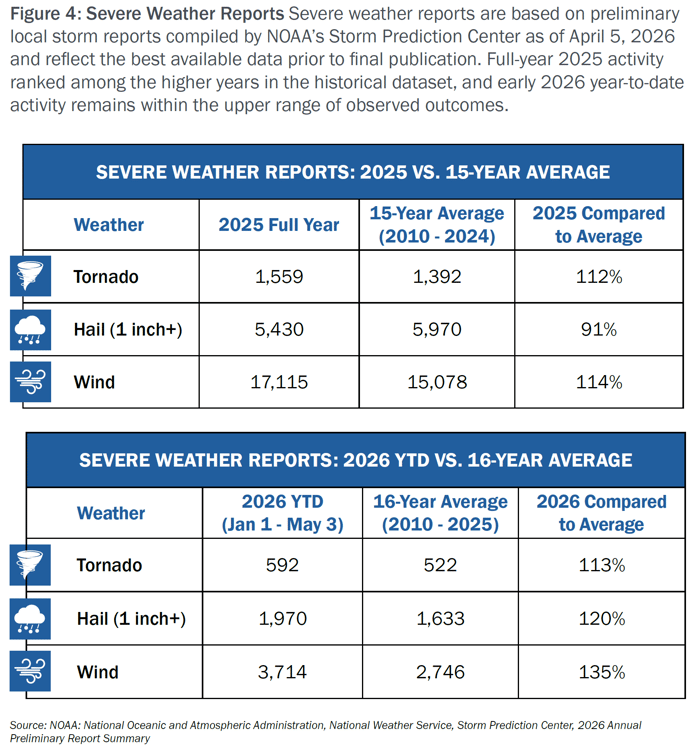
Severe convective storms (SCS) remain one of the most persistent and volatile drivers of US property catastrophe losses. See Figure 3. In recent years, tornado activity has exceeded historical baselines in four of the last five years, underscoring that frequency, not just severity, has become a primary concern for insurers. For example, 2025 recorded approximately 1,559 tornadoes compared to a long-term average of 1,392, even though fatalities were closer to historical norms. This dynamic highlights why insurers continue to pay meaningful claims even in years that do not dominate national headlines. See Figure 4.
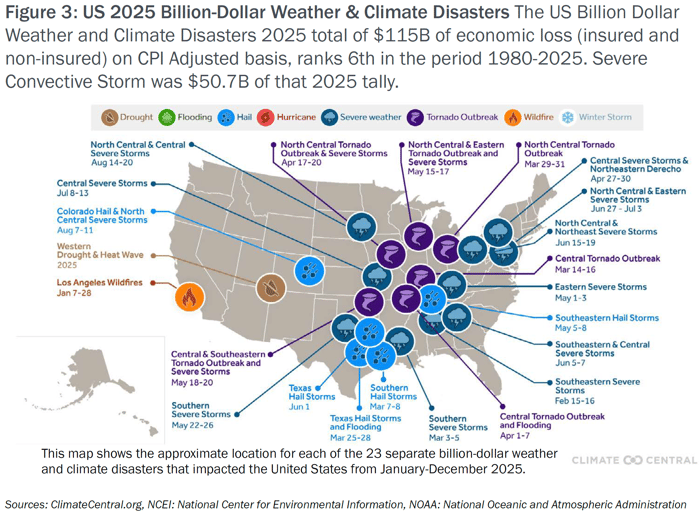
The fiscal impact of SCS events is increasingly being felt across regions that were historically considered secondary catastrophe zones. Recent multi-state hail and high-wind events, such as the March 10, 2026, outbreak affecting Oklahoma, Missouri, Texas, Illinois, Kansas, Indiana and Wisconsin, serve as reminders that losses can be highly localized while still materially affecting regional property portfolios.
As a result, underwriting scrutiny around SCS exposure remains elevated. Insurers are maintaining close focus on roof age and condition, construction type, loss history, wind and hail deductibles and actual cash value treatment on older roofs. Accurate statement of values (SOV) and complete COPE data remain critical, particularly in Midwestern and Plains states where SCS losses have been consistently meaningful. Even as pricing pressure eases in parts of the market, SCS exposed risks with incomplete data or unfavorable loss experience continue to face tighter terms.
WINTER STORMS
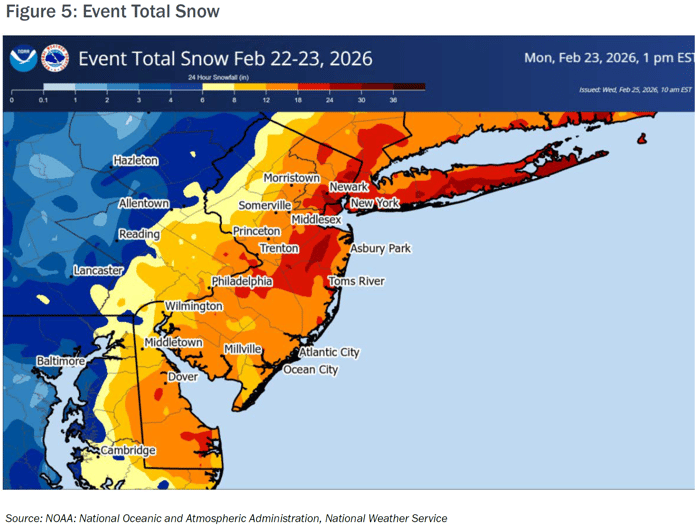
February 22—23, a Northeast US and Atlantic blizzard set many snowfall records and was accompanied by wind gusts, with many local reports of 60+mph wind gusts in NY, CT and RI. For a snow example, Providence, RI, experienced 37.9 inches of snow, their single day record dating back to the early 1900s. That snowfall was affirmed to be the new state record in March 31, 2026 report by the National Centers for Environmental Information (NCEI). Resulting effects were downed trees, snow and ice damage and power outages. See Figure 5.
WILDFIRES
Wildfire remains a peril characterized by highly concentrated severity, where a relatively small number of large events can dominate insured loss outcomes. While national fire counts and acres burned can vary year-to-year, underwriting decisions are increasingly driven by location-specific hazard and exposure concentration, rather than broad averages.
Recent national statistics illustrate this variability. For example, 2025 recorded approximately 72,000 wildfires and just over 5 million acres burned, reflecting an active season with outcomes heavily influenced by a limited number of significant events. At the same time, California continues to serve as a key market signal, with cumulative wildfire claim payments exceeding $22 billion. Even when those figures lag ultimate development, they continue to influence insurer and reinsurer sentiment around wildfire tail risk.
Underwriting remains highly granular. Insurers are focusing on defensible space, distance to vegetation, roof material, vent screening and documented risk-reduction measures, particularly in high-hazard areas. Where insureds can demonstrate credible, property-specific risk improvement, underwriters have shown greater willingness to negotiate terms. In contrast, accounts lacking clear documentation of risk controls continue to face conservative capacity deployment, despite improving overall market conditions. See Figure 6.
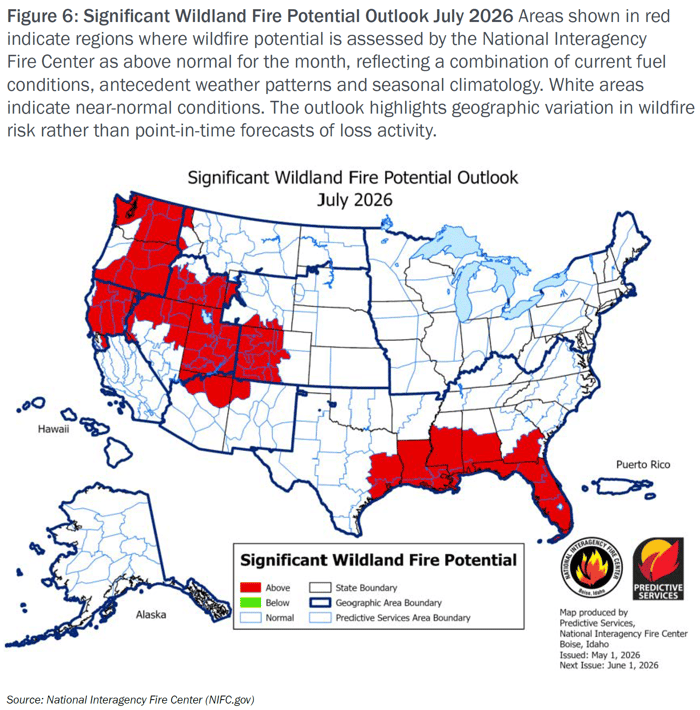
The April 1st, 2026, National Significant Wildland Fire Potential Outlook by the National Interagency Fire Center reports that 2026 fire activity is elevated across the US. As of March 31st, 1,615,683 acres burned, 231% of the previous 10-year average, and 16,746 wildfires are 168% of 10-year average. The report comments on below-normal precipitation.
The March 15th to 25th, 2026, heatwave across much of the country broke single day records and whole month temperatures were 7 to 10% higher than normal in many areas. Drought continues in 56% of the country. Overall, current conditions highlight an elevated risk profile for wildfire activity.
2026 ATLANTIC HURRICANE SEASON
Hurricane risk remains a central consideration for coastal and near-coastal property placements. While recent US landfall outcomes have been relatively favorable for property owners, insurers generally remain mindful not to equate short-term experience with reduced long-term risk. Over the most recent five-year period (2021–2025), the United States experienced approximately 10 hurricane landfalls, including 5 major hurricanes, compared to 52 total landfalls and 17 major hurricanes over the prior 30-year period (1991–2020). Notably, a higher proportion of recent landfalls have been major hurricanes, reinforcing the severity potential even when overall counts fluctuate. See Figure 7.
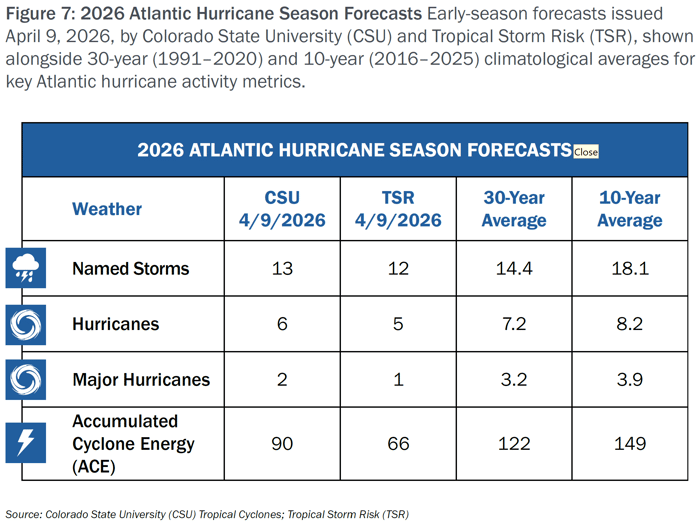
Broader basin activity also remains elevated. Atlantic Accumulated Cyclone Energy (ACE), a metric reflecting the combined frequency, intensity and duration of named storms, has run roughly 11% above the prior 30-year average over the past five years, supporting the view that activity levels remain strong even when US landfall outcomes are favorable. For example, the 2025 Atlantic season included Category 5 storms, yet the US avoided hurricane landfalls, breaking multiyear streaks of landfalls and major landfalls.
Current climatological indicators present mixed signals. Expectations for a transition toward ENSO neutral conditions with an increased likelihood of El Niño later in the season may increase vertical wind shear and suppress Atlantic storm development. At the same time, slightly warmer-than-average sea surface temperatures in parts of the Atlantic basin may act as an offsetting influence by supporting storm intensity. These competing factors help explain why insurers remain cautious and continue to rely heavily on modeled loss results, rather than short-term forecasts, when deploying capacity. NOAA’s Climate Prediction Center notes in its April 9, 2026, update a nontrivial probability that El Niño conditions could further develop, a scenario that has historically been associated with heightened vertical wind shear and reduced basin wide hurricane activity.
EARTHQUAKE
Earthquake remains a more technically disciplined segment of the catastrophe insurance market, shaped by long modeling horizons, infrequent loss emergence and portfolio-level aggregation management among specialist markets. Capacity remains available through dedicated MGA and specialty platforms, with deployment generally aligned to modeled risk parameters and portfolio concentration guidelines.
Recent renewal activity reflects a continuation of core underwriting standards, with deductibles largely holding firm and limit deployment remaining closely tied to established exposure management practices. At the same time, competitive dynamics have increased in certain segments of the market. Larger accounts with meaningful premium volume have, in some cases, experienced notable rate reductions, reflecting intensified competition for high-quality risk and increased participation by MGA driven capacity. These competitive conditions have occasionally supported structured multi-year arrangements or deferred premium mechanisms, although such outcomes remain highly selective and account-specific.
Overall pricing outcomes in the earthquake market continue to vary significantly by risk characteristics, including location, construction type, soil conditions and portfolio concentration. While broader market softening has influenced negotiations for some accounts, particularly at higher limits, earthquake underwriting remains differentiated by risk quality rather than driven by uniform market trends.
CAT PERIL SUMMARY
The E&S market continues to serve as a critical outlet for catastrophe-exposed and complex property risks. While recent insured catastrophe loss experience has moderated, supporting increased quoting activity and greater competition among insurers, underwriting differentiation remains pronounced. Insurers continue to distinguish between average risks and those that demonstrate strong construction quality, ongoing maintenance and effective risk controls.
Late-year and early-year loss experience has reinforced this dynamic. Several recent events were disruptive yet did not develop into significant commercial insurance loss drivers, allowing underwriters to maintain competitive positioning. At the same time, insurers remain mindful that regional events, particularly severe convective storm activity, can materially impact individual books, even when aggregate national losses are absorbed within existing underwriting and reinsurance structures.
Across catastrophe perils, data quality and documented risk characteristics have become essential underwriting inputs. For wildfire exposure, defensible space and reduction of structural ignitability are core considerations, while wind and hurricane underwriting continues to emphasize roof design and attachment, opening protection, elevation and documented upgrades aligned with modern building standards. Submissions that clearly evidence construction details, upgrades and verified exposure data consistently receive stronger market engagement. As competition increases, these factors are often decisive in achieving favorable pricing, retentions and terms, underscoring that risk quality and preparedness remain as important as broader market conditions.
COVERAGE SPOTLIGHT: BUILDER'S RISK
The current construction insurance market for property risks is in a comparatively favorable, though still segmented, position, shaped by moderating construction activity, improved insurer capital positions and growing volatility from secondary perils. While overall construction spending softened in 2025, especially in residential and traditional commercial sectors, activity remains robust in infrastructure, healthcare, energy, manufacturing and data center construction, sustaining demand for builder’s risk and related property coverages. See Figure 8.
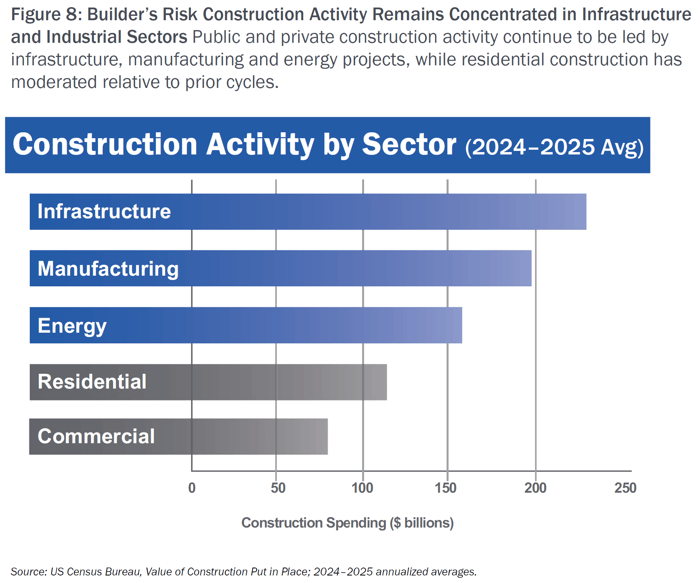
Per the Aon 2026 P&C Outlook and Aon Global Insurance Market Insights, property insurers entered 2026 with strong capital positions following favorable underwriting results in 2024 and 2025, supported by stable reinsurance outcomes and limited peak catastrophe losses in the prior year. These conditions have contributed to heightened insurer competition for preferred construction property risks, particularly in shared and layered placements where capacity is often oversubscribed. As a result, many buyers are experiencing improved to meaningful rate reductions on builder’s risk and construction property programs, particularly where prior pricing reflected heightened hazard assumptions. Underwriting flexibility has also increased around site security requirements. Advances in technology, including surveillance, access control and real-time monitoring, have materially improved loss prevention during construction. In parallel, carriers are showing greater openness both in approved security vendors and in how requirements are structured, particularly on large or high-profile projects where robust controls are clearly documented.
At the same time, underwriting remains highly segmented. Builder’s risk conditions have relaxed relative to prior years, especially for single-family residential and noncombustible commercial projects, with some buyers achieving reduced deductibles and broader terms. However, insurers continue to apply heightened scrutiny to natural catastrophe exposure, including wildfire, flood and severe convective storm risk. Catastrophe sublimits, particularly on larger projects, are frequently capped, and underwriters are closely reviewing location data, construction type, crime exposure and project timelines. Renovation projects with complex scopes or elevated loss potential continue to skew toward the E&S market, where flexibility remains essential.
The growing importance of secondary perils is a consistent theme across sources. This loss experience continues to influence how insurers deploy property capacity for construction risks, particularly in regions with known aggregation concerns. California is frequently cited as an example, where the ongoing rebuilding activity following the 2025 wildfires has reinforced underwriting focus on valuation accuracy, mitigation measures and accumulation management.
The E&S market remains a key component of construction property placements. According to AM Best’s E&S Market Segment Outlook and Swiss Re’s sigma report on surplus lines, while growth in the E&S segment has moderated, it continues to function as a structural outlet for complex construction risks that require flexible terms, higher limits or customized coverage. Projects with elevated CAT exposure, nonstandard designs or large total insurable values are still commonly placed partially or fully in the E&S market, even as admitted carriers selectively expand appetite.
RISK SPOTLIGHT: DATA CENTERS
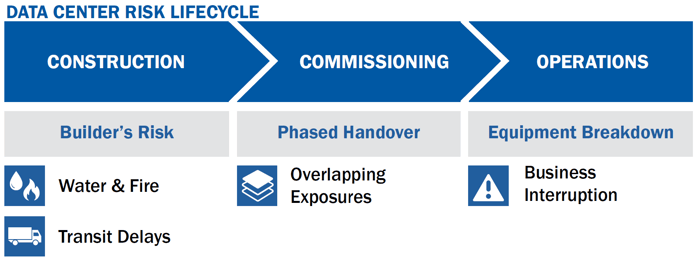
Data centers are a distinct and increasingly complex property risk class, driven by scale, asset concentration and operational criticality. Per Insurance Business (January 2026) and Munich Re, individual hyperscale facilities routinely carry total insured values exceeding $1 billion, with some campuses reaching $10+ billion dollars, creating aggregation challenges that exceed the capacity of single carriers. During construction, builder’s risk coverage functions as a project-specific property policy spanning from site preparation through handover. Data center construction introduces unique exposures, including early installation of high-value electrical and IT equipment, phased commissioning and overlap between construction and operational use. Water damage, fire, power surges and supply-chain disruption, particularly delay in startup tied to equipment transit, are among the most common and severe loss drivers during this phase.
As facilities transition into operation, the risk profile shifts materially. Property and equipment breakdown coverage becomes central, reflecting the sensitivity of servers, cooling systems, and power infrastructure. Business interruption exposure frequently exceeds physical damage, particularly where outages stem from utility service interruption, cooling failure, or power instability rather than insured physical loss. Uncertainty around business income limits and downstream dependency remains a key underwriting challenge.
Across both phases, E&S and specialty markets play a role, providing layered capacity, manuscripted wording, and flexibility around phased handover, valuation, and aggregation. Data centers are insured not as conventional real estate, rather as mission-critical infrastructure requiring bespoke property solutions across their lifecycle.
SUMMARY
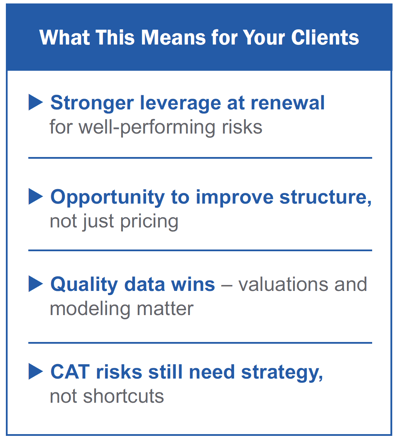
The US commercial property market has become more competitive in 2026, with improved capacity and more constructive renewal dynamics for well positioned risks. At the same time, catastrophe perils continue to drive differentiated underwriting outcomes, reinforcing the importance of disciplined program design, accurate exposure data and clear documentation of risk characteristics.
RT Specialty’s Property team is built to help retail trading partners navigate this environment efficiently and confidently. Our brokers combine deep market relationships with technical placement expertise across layered programs, delegated authority platforms and complex catastrophe-exposed risks. We collaborate closely with carriers and retail brokers to deliver thoughtful structures, responsive execution and practical guidance tailored to each submission.
As market conditions shift, disciplined processes remain a differentiator. Strong submissions, verified valuations and clear risk narratives continue to drive better engagement and more efficient placements. RT Specialty stands ready to support retail trading partners with dedicated claims advocacy, analytics support and the scale of a national platform, while maintaining the specialization and responsiveness that complex property placements demand.
THE RT SPECIALTY PROPERTY COMMITMENT
“Specialization continues to be a key focus of RT Specialty today and for the foreseeable future. During shifting property market cycles, the need for specific expertise becomes all the more apparent. The RT Property team has a deep bench of experienced brokers who understand the challenges faced by our retail broker trading partners and their insureds. Through collaboration, hard work, and our commitment to excellence, the RT Property team stands ready to provide best-in-class assistance.”
— Brenda (Ballard) Austenfeld, President of RT Specialty and CEO of the National Property Practice

RT Property is a part of RT Specialty. RT Specialty is a division of RSG Specialty, LLC, a Delaware limited liability company based in Illinois. RSG Specialty, LLC, is a subsidiary of Ryan Specialty, LLC. RT Specialty provides wholesale insurance brokerage and other services to agents and brokers. As a wholesale broker, RT Specialty does not solicit insurance from the public. Some products may only be available in certain states, and some products may only be available from surplus lines insurers. In California: RSG Specialty Insurance Services, LLC (License #0G97516) ©2026 Ryan Specialty, LLC
This Article is provided for general information purposes only and represents RT Specialty’s opinion and observations on the current outlook of the US Property Insurance market and does not constitute professional advice. No warranties, promises, and/or representations of any kind, express or implied, are given as to the accuracy, completeness, or timeliness of the information provided in this Article. No user should act on the basis of any material contained herein without obtaining professional advice specific to their situation.